Archive

Tag Archives: collaboration

Never Enough / Jamais Assez: on documentation, proximity, and Nadège Grebmeier Forget’s SUITE  from the series One on one’s for so-called fans
A text responding to a performance by Nadège Grebmeier Forget, published in the 2015 Core Program catalog

03nadege_Photo 1520

“In describing the challenges of writing about performances “in absentia,” Amelia Jones has argued that, “the problems raised by my absence… are largely logistical rather than ethical or hermeneutic. That is, while the experience of viewing a photograph and reading a text is clearly different from that of sitting in a small room watching an artist perform, neither has a privileged relationship to the historical ‘truth’ of the performance.”[1] Building upon this claim, I am interested in thinking through what it means to work with/within the logistical problems of absence. This text uses multiple and multiplying forms of documentation to negotiate my distance from the performance, less with the goal of providing a conclusive account of the event, but in a way that might hold a space for all the conflicting, affective, awkward, messy, unofficial, intimate, embodied, compromised, personal, and subjective versions of the performance.”

Download the full PDF here.

[1] Amelia Jones, “‘Presence’ in absentia: Experiencing Performance as Documentation,” Art Journal 56, no. 4, (Winter, 1997): 1

The Ladies’ Invitational Deadbeat Society’s limited edition DO LESS WITH LESS / DO MORE WITH MORE cross stitch pattern poster was first printed at the Alberta Printmakers’ Society in June 2012. The slogan was inspired by a discussion held during Artivistic’s Promiscuous Infrastructures project at Centre des arts actuels Skol in Montréal, Québec about how artists and non-profit arts organizations negotiate the constant pressure to do more with less. Reissued for FUSE Magazine‘s last issue, LIDS proposes that we resist the capitalist logic of constant acceleration, productivity, and austerity budgets by reasserting a realistic level of production within our means. Use LIDS’ handy pull out pattern to stitch a banner for your own office and hang in the orientation of your choice!

A version of the poster was also printed in PHONEBOOK 4, directory of independent art spaces, programs, and projects in the United States, in 2015; and it has been included in exhibitions Beginning with the Seventies: Glut, at the Morris and Helen Belkin Art Gallery, Vancouver, BC in 2018 and Creative Cloth: Aesthetics and Apparel at Museum London, London, ON  in 2019.

fuse1

Ladies Invitational Deadbeat Society, DO LESS WITH LESS / DO MORE WITH MORE, FUSE Magazine 31-1 WINTER 2013-14 PATTERN PULLOUT.

Photo credits: Olya Zarapina

The relationship between arts economies and austerity is a tumultuous one. We need only recall Stephen Harper’s sneering 2008 categorization of artists as rich complainers as evidence of the persistent myths that are used to devalue artistic work as “non-essential” during times of economic crisis. And yet, while the global commercial art market continues to experience steady growth and record-breaking auction sales, this profit-oriented circuit is neither possible nor desirable for many artists. Given the rich history of art works that engage with economic exchange–from artists’ storefronts and corporations to drop-out culture and performative actions of refusal–we are interested in considering the ways in which artists negotiate and respond to the simultaneous devaluation of artistic work, and increasing pressures on artists, cultural workers, and funding agencies to behave as financial speculators. In a climate of austerity budgets and precarious labour, we ask: how do artists, cultural workers, and institutions adapt and situate themselves? What kinds of identities–within cultural work and more broadly–are produced by capitalist accelerationism? On October 24 2014, as part of the UAAC conference held at OCADU in Toronto, I co-chaired a panel with Anthea Black on Performing Austerity: Artists, Work, and Economic Speculation. The panel included papers by Shannon Stratton, Michael Maranda, and Kirsty Robertson. To introduce the panel and frame some of the issues presented in the papers, we also drafted a letter to the UAAC community. What follows is a working draft of that letter that we are inviting our colleagues to read, sign, and comment on.

Read More

mille_feuilles_2
Lancement
Lieu : atelier b. (5758 boul. Saint-Laurent, Montréal)
Date : le vendredi 23 août, dès 17 h.
événement facebook

Les textes de Nicole Burisch et d’Andréanne Godin se rencontrent autour de souvenirs de la maison et du territoire originels, d’où s’étaient tissés des liens solides en apparence qui, avec le temps, se sont fragilisés, dénoués, puis reformés.

Cette publication est la deuxième parution de Mille-feuille, projet de micro-édition de courts textes littéraires et poétiques faisant écho à des œuvres d’arts visuels. Pour cette édition, Nicole Burisch a été invitée à écrire un texte en réponse à l’œuvre de l’artiste Andréanne Godin.

*

Launch
Place : atelier b. (5758 boul. Saint-Laurent, Montréal)
Date : Friday August 23, at 5pm.
Facebook event

Texts by Nicole Burisch and Andréanne Godin converge around recollections of home and landscape, places with which seemingly solid ties were woven—ties which over time became fragile, came undone, and then re-formed.

This publication is the second issue of Mille-feuille, a micro-publishing project that presents short literary and poetic texts that respond to works of visual art. For this issue, Nicole Burisch was invited to write a text in response to a work by the artist Andréanne Godin.

renseignements / information
mille-feuilles.ca
info@mille-feuilles.ca

Ever feel like your job has started to take on a somewhat performative quality? Tired that artists and athletes are getting all the recognition and the fun? Want to put your over-developed administrative skills to the test and show off your hidden talents for organizing, planning, and figuring out brilliant last-minute solutions while working under pressure with a tight budget? Have we got a race for you!

The Art Administrator’s Race is a day-long game based on popular television programs like The Amazing Race or Survivor, childhood memories of Capture the Flag, and the absurdity and humour in our day-to-day lives as arts administrators and cultural workers.

//

Avez-vous déjà eu l’impression que votre travail comporte un aspect performatif? Êtes-vous tanné-e du fait que les artistes et les athlètes sont les seul-es à recueillir la gloire? Avez-vous envie de tester vos habiletés surdéveloppées en matière d’administration des arts et de pavaner vos talents cachés pour l’organisation, la planification et la résolution de problèmes de dernière minute tout en travaillant sous pression selon un budget limité? Eh bien, nous avons une compétition pour vous!

La Course annuelle des administrateur-rice-s des arts est une compétition d’une journée, basée sur les populaires émissions de télévision telles Amazing Race et Survivor, les souvenirs d’enfance de capture du drapeau et le côté absurde et humoristique de notre quotidien d’administrateur-rice-s des arts (AA) et de travailleur-euse-s culturels.

Organised by Amber Berson and Nicole Burisch, the first (and only) race took place in Montreal on May 20th, 2013. Four teams met at Eastern Bloc and then raced throughout the Mile Ex/Little Italy/Mile End neighbourhoods to complete a set of arts-admin related challenges including:

  • Bring Your Kid to Work Wild Card Challenge

  • Schmooze with a Collector + Bonus Point Round!

  • Old technology / equipment pickup / installation challenge

  • Visit two board members who work on opposite ends of town to sign a document and then drop it off at an art council office (i.e. with the judges), in less than two hours.

  • Explain your financial statements to your membership.

The race concluded with after work drinks/judging at Alexandraplatz, where celebrity judges/board members Libby Shea, Anne Bertrand, and Saelen Twerdy evaluated each team’s performance, and tallied scores from the various challenges.

After thorough consideration (and a shocking last-minute disqualification) the results were announced:

1st place: Michelle, Anna, Sheena
2nd place: Florence, Virginie, Pedro
In a category of their own: Chris and Rose
Disqualified: Amber and Nicole

Thanks to all who participated and offered their homes, resources, and ingenuity. If you are interested in participating, contributing, or suggesting potential future challenges, please send an email to citiusaltiuspervilis(at)gmail(dot)com.

Merci beaucoup à tous les participant.e.s: Anne, Saelen Libby, Olya, Florence, Virginie, Pedro, Claudine, Chris, Rose, Sol, Michelle, Anna, Sheena, Eliane. Vous êtes toutes et tous des gagnant.e.s!

The Tory Burch FEED bag, one of the examples we address in our text.

Anthea and I have been busy working on a new body of research into the use of craft and crafted aesthetics as a form of political expression and identity construction. We recently presented a paper entitled, “Performing Austerity: Political Identities and the Co-option of the Crafted Aesthetic” at the Textile Society of America Symposium in Washington, DC. The theme of the Symposium was “Textiles and Politics” and we got to present as part of the fantastic Material Matters panel organized by Lisa Vinebaum, Ruth Scheuing, and Ingrid Bachmann.

The abstract of the paper is posted below, and there are more links, examples, and excerpts on the Performed Austerity website.

Craft has been positioned as both a fix and foil for the ills of capitalism and alienating conditions of industrialization, and the current moment, dubbed by some as a “craft revolution,” often romanticizes craft as simple, fulfilling, authentic, and politically significant work. This paper explores the use of crafted aesthetics in both consumption and anti-consumption models of social/political engagement to conspicuously perform values of personal agency, and social responsibility, as expressions of (life)style in an economic climate obsessed with austerity. We introduce the term “craftwashing” to refer to instances where craft is used to market fashionable goods whose desirability often obscures the sticky ethical, environmental, and economic questions around their production.

UNIDENTIFIED…ENIGMATIC, PERHAPS EVEN ROMANTIC
(with the Ladies Invitational Deadbeat Society)

This informal exhibition offers up a small selection of documents, photographs, texts, publications, correspondence, and art works chosen by the members of the Ladies Invitational Deadbeat Society during our summer 2012 residency at the John Snow House. Spanning the years of 1974 to 2010, these selections are the result of our collective meanderings through The New Gallery’s archives and library. The title of our exhibition is drawn from a note left in a binder of slides in 1988 by then-administrator Nelson Henricks that reads: “The following slide are unidentified, which is kund of enigmatic, perhaps even Romantic. Nevertheless, I have identified them as Clouds ‘N’ Water because of the remarkable amount of wood paneling…They are coalated into groups that are from the same film, so please don’t mix them up, not that anyone will ever look at them, or even read this.”

Read More

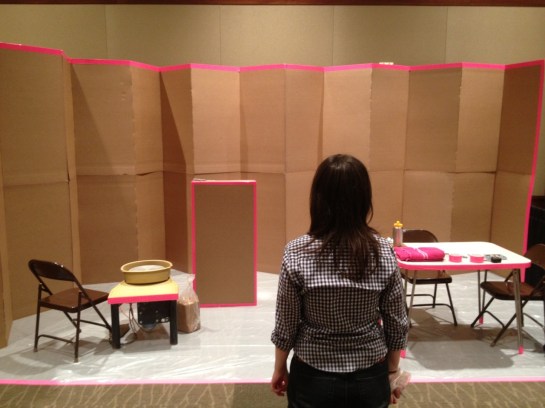
The Brick Factory @ NCECA 2012I just got back from a whirlwind trip to the annual NCECA (National Council for Education in the Ceramic Arts) conference, held in Seattle this year. I was there with the other members of The Brick Factory (a performance collective we formed during a residency at Watershed last summer). We presented a series of live performances over the course of 4 days as part of the Project Space exhibitions. Performances ranged from ceramic-themed reworkings of well-known historical performance art works, new original works created specifically for NCECA, and a few off-site interventions. For more information and documentation, check out The Brick Factory website, where we will be adding more posts soon.